

Strongest Franchise Opportunities for Tough Economic Times
Top 2025 Recession-Proof Franchise Opportunities for Steady ReturnsBest Recession‑Proof Franchise Opportunities for Stable Investments in 2025
Recession‑proof franchises are businesses built around steady needs, recurring revenue, and predictable unit economics—qualities investors look for when they want stability during economic slowdowns. This guide walks you through how resilient franchise models create financial predictability, which industries tend to hold up in recessions, and a practical checklist to compare opportunities. Many prospective owners worry about preserving capital, weaker consumer spending, and tougher financing when the economy softens; recession‑proof concepts reduce those risks by focusing on essential services and strong franchisor support. Below, we define the core traits of resilient franchises, compare leading industry categories for 2025, review reliable cleaning and sanitation concepts, contrast automotive repair with essential food & beverage, and explain how Business Builders helps match entrepreneurs to vetted opportunities. By the end, you’ll have a clear screening checklist, sample industry economics, and next steps to find franchise options that fit your risk tolerance and growth goals.
What Are Recession‑Proof Franchises and Why Invest in Them?
Recession‑proof franchises offer products or services people still buy when budgets tighten because they meet essential needs, rely on repeat purchases or contracts, and use scalable, cost‑efficient operations. These systems shift revenue away from discretionary spending toward essential maintenance—helping protect cash flow and unit margins when demand softens. For investors, that means lower revenue volatility and a better chance of securing financing or riding out short downturns. Understanding these mechanics makes it clearer why investors prioritize essential service positioning, recurring revenue, and strong franchisor support when evaluating opportunities.
Franchises that score highly on predictable demand and repeat transactions also tend to hold value better and sell more easily. Spotting those traits early saves time and money during due diligence. The following section breaks down the financial levers that drive stability and provides a brief example of predictable revenue drivers.
How Do Recession‑Proof Franchises Provide Financial Stability?
They stabilize cash flow by combining essential‑demand mechanics, recurring revenue streams, and franchisor systems that reduce surprises. Essential demand means customers buy services—healthcare, repairs, sanitation—regardless of the broader economy, creating a baseline of transactions. Recurring revenue comes from subscriptions, maintenance contracts, or habitual purchases that even out monthly income and reduce reliance on one‑off sales. Franchisor support—training, centralized purchasing, and marketing—lowers operational risk, helps new units ramp faster, and preserves margins.
For example, a home‑services franchise that sells annual maintenance plans mixes emergency call revenue with steady subscription income, making month‑to‑month revenue far more predictable than a project‑only model. Understanding these channels helps entrepreneurs run stress tests and prioritize franchisors that offer meaningful support. That leads to a short checklist of characteristics to evaluate recession resistance.
What Key Characteristics Define a Recession‑Resistant Franchise?
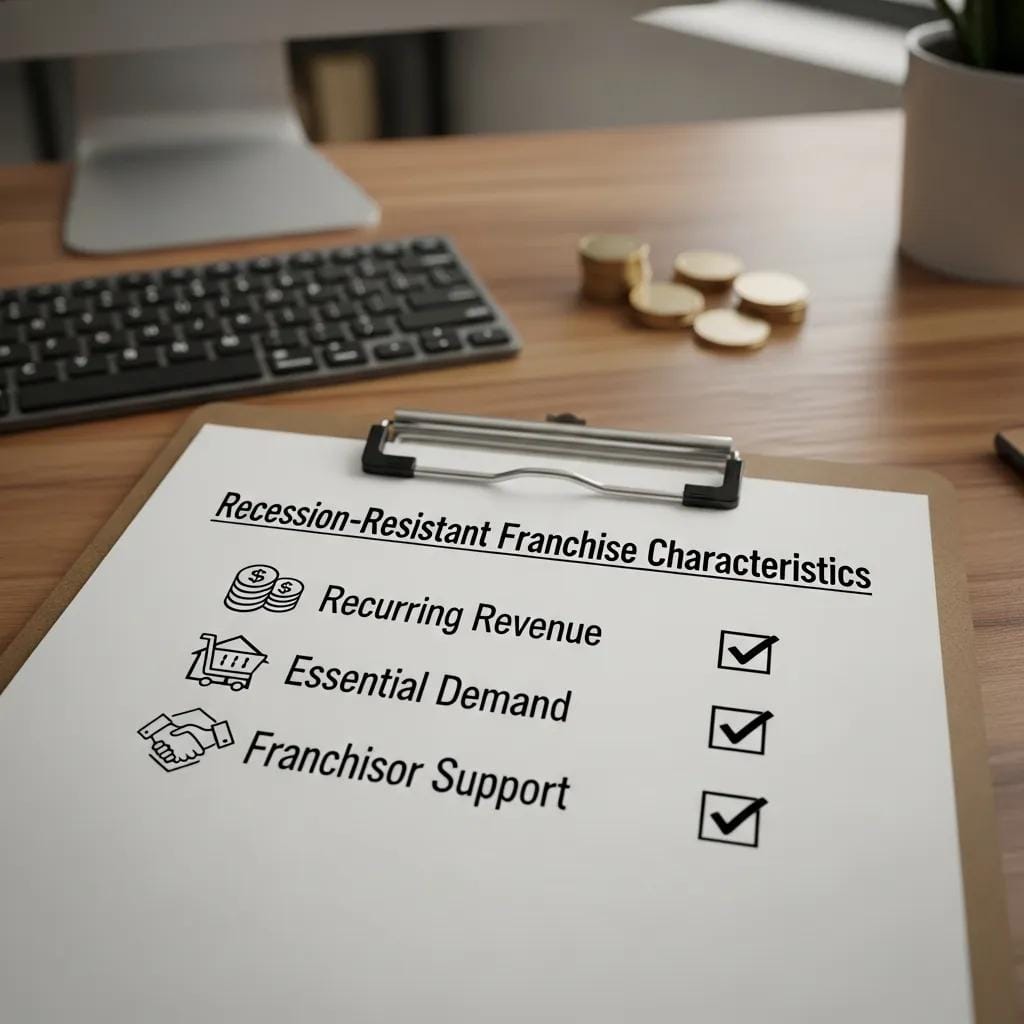
Use a simple checklist to spot franchises built for resilience. Look first for recurring revenue—contracts or subscriptions that reduce dependence on one‑time sales and improve cash‑flow visibility. Favor essential‑services positioning—healthcare, repairs, sanitation—where need, not preference, drives buying. Evaluate franchisor support: strong training, marketing, and lead generation, and stable supply chains shorten ramp time and lower operating risk. Finally, check unit economics for low variable costs and staffing models that scale profitably at modest volumes.
- Recurring Revenue: Contract or subscription income that evens out cash flow.
- Essential Demand: Services tied to safety, health, or compliance.
- Franchisor Support: Training, lead generation, and procurement that reduce operating risk.
Using this checklist during initial screening narrows your focus to franchises built for durability and prepares you for the deeper financial analysis that follows when comparing industries in 2025.
Which Industries Offer the Best Recession‑Proof Franchise Opportunities in 2025?
Industry choice matters because some sectors naturally align with non‑discretionary spending and repeat demand. In 2025, the most resilient franchise sectors are healthcare and senior care, home services (HVAC, plumbing, restoration), cleaning and sanitation, automotive repair, and essential food & beverage concepts. These areas benefit from demographic trends, regulatory needs, emergency‑driven demand, or daily habits—factors that keep transaction volumes steadier when discretionary spending drops. Picking the right industry is the first strategic step toward a recession‑resistant franchise portfolio.
Below is a concise comparison of key industries by demand stability, typical investment range, recurring revenue potential, main risks, and franchisor support to illustrate trade‑offs for prospective owners. If you want vetted options in these sectors, Business Builders can introduce entrepreneurs to curated franchise opportunities that meet these criteria and confirm financial and background requirements.
| Industry | Demand Stability | Typical Investment Range | Recurring Revenue Potential |
|---|---|---|---|
| Healthcare & Senior Care | Very high (demographic-driven) | Medium–High | High (recurring care schedules) |
| Home Services (HVAC, Plumbing, Restoration) | High (emergency & maintenance) | Medium | Medium–High (maintenance contracts) |
| Cleaning & Sanitation | High (commercial compliance + residential) | Low–Medium | High (contracts/subscriptions) |
| Automotive Repair | High (necessity & fleet work) | Medium | Medium (repeat customers, fleet contracts) |
| Essential Food & Beverage | Medium–High (daily needs) | Medium | Medium (high-frequency purchases) |
That table shows that healthcare/senior care and cleaning/sanitation typically deliver the most consistent recurring revenue, while home services and automotive commonly experience strong emergency‑driven demand. Next, we look at why healthcare and senior care remain especially resilient.
Why Are Healthcare and Senior Care Franchises Considered Recession‑Resistant?
Healthcare and senior care franchises hold up well because aging populations and ongoing chronic care create steady demand that’s less tied to economic cycles. A growing senior cohort means more in‑home care, assisted‑living support coordination, and allied‑health services—often delivered through scheduled plans that generate recurring revenue. A mixed payer environment—private pay, insurance, and government programs—can buffer household sensitivity to downturns and help protect revenues. Franchisors in this space typically offer licensing guidance, compliance support, and clinical training that lower operator risk and maintain quality standards.
Those structural and regulatory dynamics make senior care attractive to investors seeking p,ctability and mean,iandact alongside returns. From there, it’s useful to compare how home services generate steady volume through different mechanics.
How Do Home Services Franchises Like HVAC, Plumbing, and Restoration Thrive During Economic Downturns?
Home services succeed because many repairs and safety‑critical maintenance items are non‑discretionary: homeowners may postpone upgrades but rarely delay heating repairs, plumbing emergencies, or mold remediation. Emergency work often pulls premium pricing, and fast response builds loyalty and referrals; preventive maintenance contracts add recurring revenue. Franchise systems standardize dispatch, parts procurement, and technician training to tighten margins and speed service—actions that increase resilience when demand softens. Better scheduling and inventory control also lower variable costs and protect profitability during slow periods.
Comparing HVAC, plumbing, and restoration, HVAC and plumbing combine emergency calls with seasonal maintenance, while restoration often relies on insurance‑driven work that can insulate cash flow. Those differences matter when choosing a franchise and lead into cleaning and sanitation, where compliance‑driven demand is growing.
What Are the Top Stable Cleaning and Sanitation Franchise Opportunities?

Cleaning and sanitation franchises sit in a steady niche because ongoing hygiene standards, compliance requirements, and heightened public‑health awareness create persistent B2B and B2C demand. Commercial contracts for offices, medical centers, and food‑service sites often demand scheduled cleaning and certifications, producing sticky revenue. Residential subscription cleaning adds a consumer recurring stream that scales with relatively low capital when models are van‑ or crew‑based. For entrepreneurs seeking lower upfront costs and contractable revenue, cleaning concepts can be a compelling recession‑resistant choice.
The cleaning sector includes commercial contract specialists, recurring residential services, and specialized sanitation/biodecontamination providers—each with different unit economics and scalability. The table below summarizes typical franchise characteristics to help evaluate lower‑risk examples.
| Cleaning Franchise Type | Investment Range | Typical Unit Economics | Support Offered |
|---|---|---|---|
| Commercial Contract Cleaning | Low–Medium | High margin on recurring contracts | Bidding tools, compliance training |
| Residential Recurring Cleaning | Low | Predictable per-client revenue, low capex | Marketing, scheduling platforms |
| Specialized Sanitation Services | Medium | Higher per-job revenue, B2B focus | Technical training, supply procurement |
This comparison shows commercial contract models often provide the most stable cash flow, while residential concepts have lower entry costs and faster break‑even timelines. With those types in mind, we’ll explain how sustained demand supports stability and what low‑risk features to prioritize.
How Does Increased Demand for Cleaning Services Support Franchise Stability?
Demand for cleaning services has shifted since 2020: clients expect routine sanitation, documented protocols, and vendor compliance. Commercial customers often lock in multi‑month or annual contracts to meet health standards, giving franchisees recurring revenue and predictable schedules. Residential subscription demand remains strong as busy households outsource cleaning. Franchises scale crews to lower marginal labor costs as volume grows, and centralized lead generation and account management from franchisors help keep new business steady.
Those demand drivers reduce seasonal swings and make cash‑flow forecasting easier—an important factor when evaluating lower‑risk investments. The next section lists the franchise attributes that most often signal lower investment risk in cleaning concepts.
Which Cleaning Franchises Offer Low‑Risk Investment Options?
Low‑risk cleaning franchises usually share several traits: low startup capital (mobile, van‑based operations), strong franchisor marketing and lead support, transparent unit economics with realistic payback expectations, and scalable staffing that keeps fixed costs low. Prioritize franchisors that supply sales pipelines, contract templates, and account‑management training to speed client retention. Mobile models avoid costly real estate and can serve multiple markets, while certified sanitation specialists can command higher B2B pricing.
- Low Upfront Capital: Minimal real estate and equipment speeds break‑even.
- Franchisor Lead Support: Centralized marketing shortens time‑to‑first‑contract.
- Contract‑Based Revenue: Multi‑month agreements steady cash flow and help with financing.
Reviewing these features during discovery helps identify cleaning franchises that balance lower risk with growth potential. From cleaning, we move to automotive repair and essential food & beverage—two other resilient sectors.
How Do Automotive Repair and Essential Food & Beverage Franchises Maintain Stability in Recessions?
Automotive repair and essential food & beverage concepts stay steady because they serve regular, necessity‑driven needs—vehicle maintenance and daily food. Automotive repair benefits from safety‑driven spending and fleet contracts that produce recurring work, while essential F&B captures habitual traffic and quick transactions. Both rely on efficient unit economics, reliable supply chains, and franchisor systems that protect brand consistency and margins. Comparing operating costs and demand elasticity clarifies why these sectors remain defensible.
| Sector | Operating Costs | Customer Retention Drivers | Demand Elasticity |
|---|---|---|---|
| Automotive Repair | Moderate (tools, equipment) | Warranty work, fleet contracts, trust | Low elasticity for necessary repairs |
| Essential F&B | Medium (product & labor) | Convenience, daily habit, location | Moderate elasticity but high frequency |
| Combined Resilience Factors | Training & supply agreements lower variance | Repeat customers and contractual work | Necessity anchors baseline demand |
These contrasts help entrepreneurs weigh capital needs, staffing models, and location strategy when judging resilience. Next, we dig into why standardized automotive franchises are advantaged in downturns.
What Makes Automotive Repair Franchises Resilient During Economic Uncertainty?
Automotive repair franchises are resilient because drivers prioritize safety and mobility even when they cut other spending. Regular maintenance, warranty, insurance repairs, and fleet servicing generate recurring revenue streams. Franchisors provide standardized diagnostics, parts procurement networks, warranty relationships, and technician training that boost throughput and margin consistency. Efficient shop layouts and scheduling systems reduce overhead and maximize billable labor, helping franchisees stay profitable even with softer demand.
Those operational efficiencies and contract opportunities reduce revenue swings and create clearer cash‑flow forecasts for lenders and owners. The next section explains why some F&B formats are better positioned as lower‑risk investments.
Why Are Food and Beverage Franchises Considered Low‑Risk Investments?
Not every F&B concept is recession‑proof, but essential formats—convenience stores, value‑oriented quick‑service, and everyday staples—are relatively low‑risk because they meet daily needs and drive frequent visits. Low average tickets with high transaction volume can preserve gross margin when budgets tighten, and established franchisors offer supply‑chain scale and brand recognition that lower marketing costs. Evaluate location density, unit throughput, and commodity exposure to separate resilient essential concepts from discretionary premium dining, which is more cyclically sensitive.
- High Frequency, Low Ticket: Frequent purchases stabilize total revenue.
- Franchisor Supply Chains: Central purchasing limits cost swings.
- Location & Value Positioning: Smart placement and value menus keep traffic steady.
With a clear understanding of industry drivers and franchise traits, entrepreneurs can start matching interests to vetted opportunities—something Business Builders facilitates with a structured approach.
How Does Business Builders Connect Entrepreneurs with Vetted Recession‑Proof Franchise Opportunities?
Business Builders links aspiring and experienced entrepreneurs with proven franchise opportunities, focusing on curated matches that fit an investor’s profile. We start by understanding your goals, capital, and background, then present franchised options that meet resilience criteria—recurring revenue, essential service positioning, and solid franchisor support. The process is advisor‑led, transparent, and practical: we confirm investment ranges and unit economics, outline franchisor support levels, and map clear next steps for formal discovery.
This approach keeps you focused on opportunities that align with your stability, rather than browsing broadly. The subsection below breaks down the matching process so you know what to expect.
What Is the Process for Matching Entrepreneurs to Suitable Franchise Options?
Business Builders follows a stepwise process that aligns entrepreneurs with vetted franchises while confirming fit and feasibility. First, discovery captures your goals, available capital, and experience to narrow industry categories. Next, financial and background vetting verifies basic eligibility and refines the list to franchises with compatible investment ranges and support models. Then advisors present curated options with comparative insights and help arrange franchisor discovery. Ongoing guidance supports introductions and review of franchise disclosure documents and unit economics.
- Discovery: Map goals, capital, and experience to opportunity types.
- Vetting: Financial and background checks confirm eligibility.
- Presentation: Curated options with comparative insights and next steps.
This clear pathway speeds decision‑making and reduces time wasted on mismatched concepts. After process steps, it helps to look at real outcomes: how success stories show the value of recession‑proof franchises.
How Do Success Stories Demonstrate the Value of Recession‑Proof Franchises?
Well‑framed success stories show resilience through measurable results—revenue stability during downturns, high client retention, and realistic payback timelines. Case examples that highlight franchisees who kept cash flow steady with recurring contracts, replaced lost foot traffic with franchisor marketing, or converted emergency repairs into maintenance contracts illustrate practical advantages. Business Builders encourages anonymized, metric‑driven profiles so entrepreneurs see how a matched opportunity performed under stress.
Those examples validate the screening checklist and franchisor support claims, making it easier to forecast break‑even timing and long‑term returns. With matching and outcome evidence in view, entrepreneurs usually have specific due‑diligence questions—answered next in a concise FAQ format.
What Are Common Questions About Investing in Recession‑Proof Franchises?
Prospective investors often ask about required investment, how to evaluate financials, and how to stress‑test assumptions; clear answers set expectations and guide next steps. Below are straightforward responses to the most common questions entrepreneurs raise when considering recession‑resistant franchises—designed to speed initial screening and support practical due diligence.
- These questions help frame initial feasibility and priorities.
- Direct answers reduce ambiguity during early evaluations.
- They also point toward deeper FDD review and unit‑level analysis.
What Is the Average Investment Required for a Recession‑Resistant Franchise?
Investment varies by industry and model, but you can think in three broad tiers. Low‑investment models—often cleaning, mobile services, or small residential concepts—need modest startup capital for a vehicle and equipment and usually avoid real estate. Medium‑investment models—many automotive shops or essential quick‑service F&B units—require equipment, fixtures, and moderate build‑out costs. High‑investment franchises—certain healthcare facilities or larger multi‑service hubs—need more capital for staff, licensing, and real estate. Financing options and franchisor relationships will influence feasibility and payback timelines.
- Low: Mobile or van‑based operations with minimal real estate.
- Medium: Shop or storefront models with equipment and build‑out.
- High: Facility‑based care or multi‑unit operations with staffing needs.
Use this framework to narrow targets before you dig into detailed financials and modeling.
How Can Entrepreneurs Evaluate Franchise Financials for Stability?
Evaluating franchise financials means focusing on FDD metrics and unit economics that reveal resilience under stress. Key items include average unit revenue, royalty and marketing fees, historical franchisee EBITDA ranges, and customer concentration risk. Build stress cases—e.g., simulate 15–30% revenue declines—to test fixed‑cost absorption and payback under conservative assumptions. Also review franchisor support—lead generation, supplier agreements, and training—which affects how quickly a new unit can reach sustainable volume and how downside risk is mitigated.
- Inspect FDD Metrics: Average gross revenue and profit ranges, initial and ongoing fees.
- Model Stress Cases: Run conservative scenarios to test break‑even resilience.
- Assess Support: Documented lead gen and procurement discounts that reduce unit exposure.
Following this checklist keeps due diligence practical and focused.
For tailored matching help from Business Builders—who connect entrepreneurs with vetted, high‑performing franchise opportunities and provide advisor‑led guidance on financial and background requirements—consider starting a discovery conversation to map your goals to industry‑aligned options and next steps.
Frequently Asked Questions
What are the most common challenges faced by franchisees in recession-proof businesses?
Franchisees in recession-proof businesses may face challenges such as maintaining consistent customer engagement and managing operational costs. Even essential services can experience fluctuations in demand due to local economic conditions or competition. Additionally, franchisees must navigate supply chain issues, especially during economic downturns when costs may rise. Effective marketing and customer retention strategies are crucial to overcoming these challenges and ensuring steady revenue streams.
How can I finance a recession-proof franchise investment?
Financing a recession-proof franchise can be approached through various avenues. Many franchisors offer financing options or partnerships with lenders familiar with franchise models. Additionally, entrepreneurs can explore Small Business Administration (SBA) loans, which often have favorable terms for franchise investments. Personal savings, investment from family or friends, and crowdfunding are also viable options. It’s essential to prepare a solid business plan to present to potential lenders, highlighting the franchise’s recession-resistant qualities.
What role does location play in the success of a recession-proof franchise?
Location is critical for the success of a recession-proof franchise. High-traffic areas with a stable customer base can enhance visibility and accessibility, driving consistent sales. Proximity to essential services, such as healthcare facilities or residential neighborhoods, can also boost demand for services like cleaning or automotive repair. Conducting thorough market research to understand local demographics and competition is vital for selecting the best location to maximize revenue potential.
Are there specific training programs for franchisees in recession-proof sectors?
Yes, many franchisors in recession-proof sectors offer specialized training programs tailored to their business models. These programs often cover operational procedures, customer service, marketing strategies, and compliance with industry regulations. Ongoing training and support are also standard, helping franchisees adapt to market changes and improve their operational efficiency. This training is crucial for maintaining service quality and ensuring franchisees can effectively manage their businesses during economic fluctuations.
How do I evaluate the long-term viability of a recession-proof franchise?
To evaluate the long-term viability of a recession-proof franchise, analyze its historical performance during economic downturns, focusing on revenue stability and customer retention rates. Review the franchise’s business model, including its reliance on essential services and recurring revenue streams. Additionally, assess the franchisor’s support systems, including training, marketing, and supply chain management. Speaking with current franchisees can provide valuable insights into the franchise’s operational challenges and successes over time.
What are the trends shaping the future of recession-proof franchises?
Trends shaping the future of recession-proof franchises include increased demand for health and wellness services, a growing emphasis on sustainability, and the rise of technology-driven solutions. As consumers prioritize health and hygiene, franchises in cleaning, sanitation, and healthcare are likely to thrive. Additionally, the integration of technology for operational efficiency and customer engagement is becoming essential. Staying informed about these trends can help entrepreneurs identify promising franchise opportunities that align with evolving market needs.
What are the benefits of investing in recession‑proof franchises?
Investing in recession‑proof franchises reduces revenue volatility and helps maintain cash flow during downturns. These businesses typically deliver essential services that remain in demand regardless of consumer spending patterns and often use recurring revenue models to enhance predictability. Strong franchisor support—training, marketing, and operational systems—further improves efficiency and lowers risk, making these franchises attractive to investors seeking steadier returns and long‑term growth potential.
How can I assess the risk of a recession‑proof franchise?
Assess risk by evaluating demand stability, recurring revenue potential, and the level of franchisor support. Check whether the franchise provides essential services customers need regardless of the economy, whether contracts or subscriptions smooth cash flow, and how the franchisor supports new units with training, marketing, and procurement. Reviewing historical performance metrics and speaking with current franchisees will round out your assessment of resilience and risk.
What types of support do franchisors typically offer for recession‑proof franchises?
Franchisors commonly provide comprehensive training, operational playbooks, marketing and lead‑generation support, and centralized procurement to lower supply costs. Many offer compliance assistance and ongoing coaching to help franchisees hit performance targets. This support network matters more in uncertain times because it speeds ramp‑up and helps maintain steady customer acquisition.
How do I determine if a franchise is truly recession‑proof?
To judge whether a franchise is genuinely recession‑proof, research its business model and demand drivers. Look for essential services (healthcare, automotive repair, cleaning) with recurring revenue elements. Analyze financials for historical performance during downturns and talk to existing franchisees about their experience in slower markets. Combined, these steps reveal whether a concept has repeatedly demonstrated resilience.
What are some common misconceptions about recession‑proof franchises?
A common misconception is that recession‑proof means immune to all economic pain. Even resilient franchises can face lower demand or supply issues. Another mistake is assuming every essential‑service franchise performs equally—individual franchisor systems, local markets, and execution matter. Continually evaluate opportunities on their specific economics and support rather than relying on labels alone.
How can I find reputable recession‑proof franchise opportunities?
Finding reputable opportunities combines research and networking. Review industry reports and franchise directories focused on resilient sectors, attend franchise expos to meet franchisors and franchisees, and consider working with consultants or organizations like Business Builders that curate vetted matches based on your goals and capital. This structured approach helps you find franchises that align with your investment criteria and risk tolerance.
Conclusion
Recession‑proof franchises offer a path to steadier cash flow and reduced revenue volatility by focusing on essential services and recurring revenue. Knowing the key characteristics and industry dynamics helps you separate resilient opportunities from riskier, discretionary concepts. If you want tailored, vetted franchise options that match your goals and financial profile, connect with Business Builders to start a focused discovery conversation.