

Micro-Franchises on a Shoestring: A Practical Guide to Affordable Franchise Ownership with Minimal Investment
As a seasoned advisor in the franchise industry, I’ve seen firsthand how micro-franchises offer a realistic route into franchise ownership, especially for those without deep pockets. They bundle a proven brand, operating playbook, and training into a much smaller startup than a traditional franchise, making them a truly. This guide, drawing on my extensive experience, walks you through what a micro-franchise is, why it’s a smart fit for small budgets, which low-cost industries to target, how to finance and buy one, and how to run a home-based or mobile operation that’s flexible and profitable. Many prospective owners get stuck finding vetted options or figuring out financing; micro-franchises reduce those risks with established branding, ongoing support, and lower overhead. Read on for clear definitions, industry comparisons, financing options and checklists, home-based profiles, step-by-step buying guidance, and practical success strategies used by lean franchisees. Where applicable, we explain how Business Builders can match you with vetted opportunities and financing-friendly options—no pressure, just options. Use this guide to assess fit, secure funding, and make a confident, low-capital purchase.
What Is a Micro-Franchise and Why It’s a Smart Fit for Small-Budget Entrepreneurs
At its core, a micro-franchise is a compact franchise model that delivers franchising’s main benefits—brand recognition, repeatable systems, and training—while keeping the initial investment far smaller. That smaller footprint usually comes from reduced territory sizes, simpler service menus, or home- and mobile-based setups. The idea is to standardize a focused, repeatable offering so an individual operator can start with modest equipment and limited overhead. The payoff: faster paths to break-even, reduced financial exposure, and access to franchisor support that would be hard to create on your own. That’s why it is a common entry point for entrepreneurs.
Micro-franchises bundle the typical franchise pieces—initial investment, royalties, training, and territory arrangements—into a tighter, more affordable package. Here are three core benefits to keep in mind:
- Lower Upfront Cost: Smaller territories and home-based formats reduce initial capital requirements, making them a low-investment business.
- Proven Systems: You work from tested processes that reduce execution risk and everyday guesswork.
- Faster Path to Revenue: Lean overhead and targeted services make it easier to reach positive cash flow.
Those advantages lead naturally into the features that differentiate one micro-franchise from another.
Ready to Explore Your Micro-Franchise Options?
Discover vetted, micro-franchise opportunities tailored to your budget and skills. Our experts can help you navigate the options and find your perfect fit.
How Micro-Franchises Work: Key Characteristics of a Minimal Investment Business
Micro-franchises share several consistent traits that make them accessible to entrepreneurs with limited funds: modest startup costs, often limited or non-exclusive territories, streamlined operating models, and franchisor-led training and systems. Investments are typically much lower than those for traditional franchises because these models avoid the costs of expensive real estate and extensive inventory. Standard features include modular service offerings, short equipment lists, digital tools for client acquisition, and mandatory initial training that shortens the learning curve. Together, these elements create a repeatable, scalable unit that suits part-time owners, solo operators, and people transitioning from employment to business ownership. From my perspective, this focus on efficiency is what truly defines a brand in the franchise world.
Because micro-franchises trade scale for simplicity, strong onboarding and ongoing support are usually part of the package—handy for owners with limited prior experience, the following section shows how those features translate into real-world benefits.
Practical Advantages for Low-Investment Owners
Micro-franchising removes several common barriers to starting a business: it reduces capital needs, simplifies operations, and lowers customer-acquisition costs. New owners get branded marketing materials, tested pricing, and training that shortens the startup learning curve—factors that improve survival odds compared with going it alone. Many offer part-time schedules, helping owners manage personal risk while they build skills and a customer base. And since many micro-franchises are service- or mobile-based, fixed costs remain low, improving early cash flow and return on investment. This makes them an ideal entry point into entrepreneurship.
Those benefits point to specific industries where micro-franchises tend to thrive; the next section maps the most promising low-cost sectors.
Which Low-Cost Industries Offer the Best Micro-Franchise Opportunities?
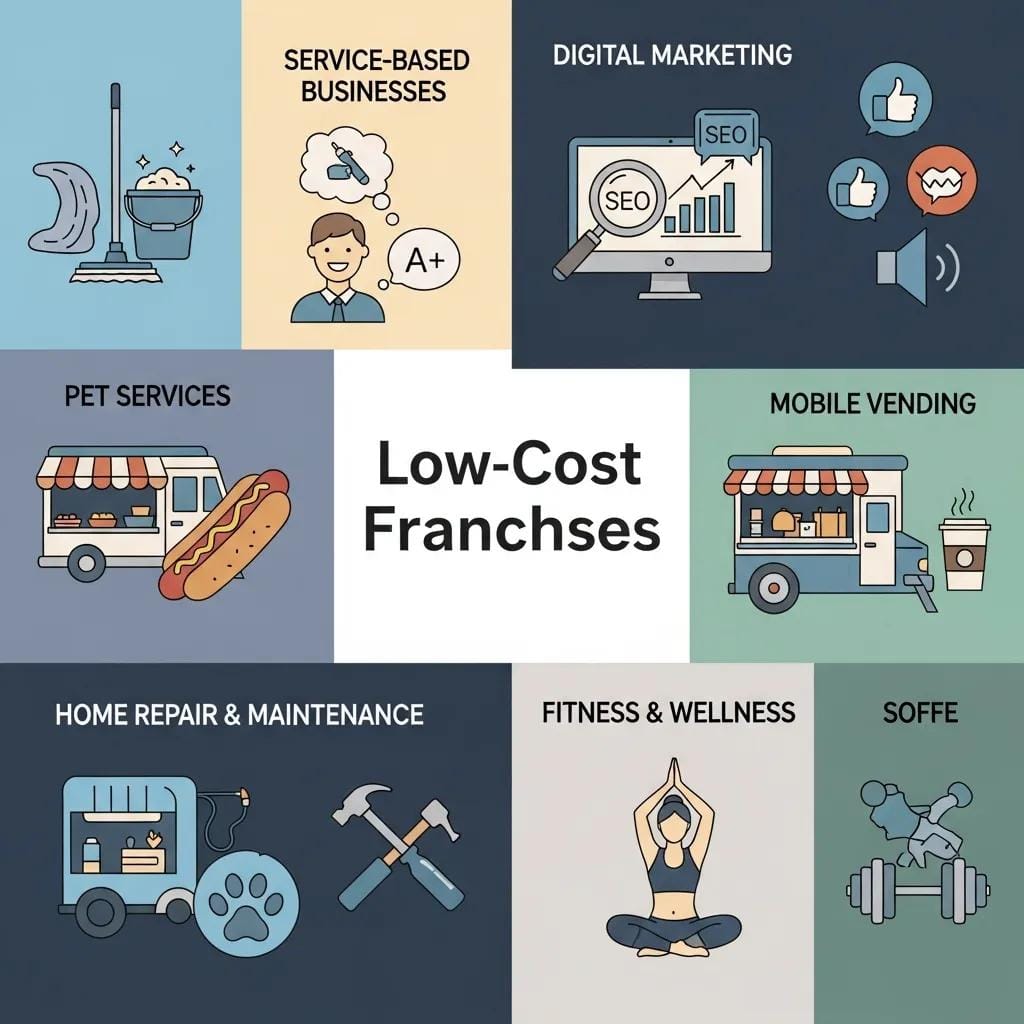
Micro-franchises are most common where human capital, modest equipment needs, and repeat demand keep costs down while preserving margins. Service businesses, home-based consultancies, mobile vending, and low-overhead retail concepts dominate because they grow through repeat customers rather than big inventories. Comparing industries by investment, overhead, and likely ROI helps you match options to your budget, skills, and goals. As the U.S. Small Business Administration (SBA) often highlights, choosing a business model with inherently lower overhead significantly boosts your chances of success.
The table below gives a quick industry comparison to filter by budget and operational fit.
| Industry | Typical Investment Range | Typical Overhead | Key Advantages | Example Micro-Franchises |
|---|---|---|---|---|
| Service-Based (cleaning, tutoring) | $5,000–$25,000 | Low (labor, supplies) | Quick start, recurring revenue | Cleaning micro-franchise; Tutoring micro-franchise |
| Digital/Marketing Services | $2,500–$20,000 | Very low (software, home office) | High margins, scalable remotely | Digital marketing micro-franchise |
| Home-Based Consulting & Travel | $1,000–$15,000 | Minimal (home office) | Flexible schedule, low fixed costs | Home-based travel agency micro-franchise |
| Mobile & Vending | $3,000–$30,000 | Moderate (vehicle/equipment) | Mobility, direct sales channels | Mobile vending micro-franchise |
Use these contrasts to narrow your search to industries that fit your capital, skills, and growth preferences. The sections below dive deeper into service-based and home/mobile models, highlighting opportunities for a startup.
Service-Based Micro-Franchises: Cleaning, Tutoring, and Digital Marketing
Service-based micro-franchises are common because they rely on people delivering repeatable services rather than holding extensive inventories, keeping capital needs low. Typical startup costs include training or certification, basic supplies or software, a modest marketing budget, and any local licensing. Helpful skills include client management, reliable scheduling, and basic digital literacy for billing and marketing. Services are often sold as subscriptions or recurring contracts, which makes cash flow more predictable than with one-off retail sales. From my experience, these models are excellent for achieving a quick return on investment.
If you choose a service-based model, prioritize franchisor support for lead generation and training—those two things usually determine how quickly you earn your first paying customers. That sets up proper entry points for comparison with home-based and mobile models, which trade off different benefits.
Home-Based and Mobile Micro-Franchises: Travel, Consulting, and Vending
Home-based and mobile micro-franchises offer strong flexibility: working from home removes storefront overhead, while mobile formats let you reach customers in multiple locations. Licenses and permits depend on the model—food vending often requires health permits, while consulting and travel focus more on certifications and a strong online presence. Customer acquisition differs too: home-based owners typically use digital marketing and referrals, while mobile operators rely on event calendars, local partnerships, and in-person selling. These are prime examples of business models that offer significant autonomy.
These models suit entrepreneurs balancing family commitments or easing into ownership. The following section outlines approaches for these low-cost entry points into franchising.
How Can You Finance a Micro-Franchise on a Small Budget?
Financing usually combines small franchisor loan programs, personal savings, microloans, and community bank products designed for low-investment businesses. Because capital needs are smaller, people with limited credit histories or modest collateral can often find viable paths—if they come prepared with clear budgets and realistic cash-flow projections. Prioritize funding for initial fees, essential equipment, and a working-capital runway of several months to cover early marketing and client acquisition. This strategic approach is crucial for any.
Below is a comparison of common financing choices to help you weigh trade-offs and eligibility.
| Financing Option | What It Covers | Typical Eligibility | Pros | Cons |
|---|---|---|---|---|
| Franchisor Financing | Franchise fee, training, and sometimes equipment | Varies by franchisor; often, revenue history is not required | Reduces upfront cost; aligned incentives | May carry a higher effective cost or restrictions |
| Community Bank / Credit Union Loan | Equipment, working capital | Local approvals, credit history required | Relationship-based, flexible terms | Longer approval times; collateral may be required |
| SBA Microloans / Small Business Loans | Working capital & startup costs | Business plan, some credit history | Lower rates for qualified applicants | Complex application process; time-consuming |
| Personal Savings / Family | Any startup needs | Immediate control | No interest, fast access | Personal financial risk |
| Grants / Government Programs | Specific training, equipment, and disadvantaged entrepreneurs | Program-specific criteria | Non-dilutive funding | Competitive, limited coverage |
Next, we explain franchisor financing, traditional loan routes, and steps you can take to improve your venture’s approval chances.
Franchisor Financing and Traditional Loan Routes for Minimal Investment Businesses
Many franchisors finance part or all of the franchise fee, and sometimes training or equipment, so new franchisees can start quickly with manageable payments. Terms differ—some programs are interest-bearing short-term plans, and some use third-party lending partners. Community banks and credit unions can also be good fits for micro-franchises when you present a concise business plan and realistic cash-flow projections; local lenders often understand small-scale models better than big banks. To strengthen your application, prepare a clear budget, highlight relevant experience, and show conservative revenue assumptions. As a franchise consultant, I always advise clients to thoroughly explore these options, as they can significantly reduce the initial financial burden.
Business Builders can help by pointing you to franchise systems that offer franchisor financing or by matching you to opportunities that fit your financial profile—an easy, no-pressure way to explore funded options. The following section covers public programs and cost-saving tactics to stretch startup dollars.
Government Programs and Smart Cost Management for Very Low-Cost Startups
Government and nonprofit programs sometimes offer grants, training subsidies, or microenterprise support that can offset startup costs; availability varies by location and target groups. For instance, the SBA offers various grant programs, though direct grants for starting a business are rare. To position yourself for those programs and reduce cash needs, create a prioritized expense list, ask franchisors about phased payments, and design a lean operating plan that postpones nonessential purchases until after you have revenue. Also, talk to an accountant about tax deductions for startup expenses and home-office rules—those can affect early cash flow, making your venture even more manageable.
- Practical cost-management checklist:Buy only essential equipment first—consider leasing or good-condition used gear.
Ask for phased payments or training schedules to spread upfront costs.
Build a 3–6 month runway to cover marketing and operating expenses while you ramp up.
Leverage free or low-cost digital marketing tools before investing in paid campaigns.
You can work actively within your community to generate early leads and referrals.
These tactics increase launch resilience and set the stage for profitable scaling. The following section focuses on home-based opportunities for owners seeking maximum flexibility.
Best Home-Based Micro-Franchises for Flexibility and Profit

Home-based are among the most budget-friendly ways into franchise ownership because they remove storefront rent and let you use existing home-office resources. Profitability depends on choosing a high-margin service or digital offering that matches your skills and local demand. Common home-based examples include remote digital marketing services, tutoring or education programs, travel consulting, and professional consulting delivered virtually or by appointment. These formats appeal to entrepreneurs who want schedule control, low fixed costs, and the option to scale through subcontractors or remote staff. They truly embody the spirit of a.
Picking the right home-based model means balancing your strengths with market demand and any required certifications. The following subsections outline lifestyle benefits and sample profiles with realistic investment and time-to-revenue expectations.
Work-Life Balance Benefits of Home-Based Micro-Franchises
Home-based micro-franchises cut fixed costs and give you scheduling flexibility, so you can grow the business part-time while you test demand. Lower overhead means more of your revenue flows to the bottom line—especially for knowledge-based services where time is the main expense. These models usually rely on digital marketing, referrals, and local networking, which keeps customer-acquisition costs manageable. For people juggling family responsibilities or easing into entrepreneurship, predictable hours and reduced financial risk make home-based models very appealing. This flexibility is a key reason why many choose a home-based franchise.
That said, success requires discipline—set boundaries, keep a clear schedule, and use structured customer-acquisition plans. The following section offers concrete examples to consider.
Top Affordable Home-Based Franchise Examples for a Very Low Cost Entry
Affordable home-based often leverage skills you already have and need modest funds for certification, software, and marketing. Examples to consider: a digital marketing micro-franchise using social media and search ads with low software overhead; a tutoring micro-franchise offering online or in-person lessons with minimal materials; or a niche travel consultancy managed remotely. These profiles generally fall within the micro-franchise investment ranges above and can reach revenue quickly if you focus on repeat customers and subscription-style services. From my observations, these are some of the most accessible paths to owning a.
Which option fits you depends on your background, income timeline, and comfort with sales. The following section shows how others have turned small investments into steady businesses and the typical patterns you can replicate.
How Entrepreneurs Turn Micro-Franchises into Success on a Small Budget
Successful micro-franchise owners usually follow a simple playbook: pick a market-aligned niche, stick to franchisor systems, run disciplined local marketing, and protect cash reserves during the launch. Top performers prioritize service quality to drive referrals, reinvest early profits into customer acquisition, and use franchisor training to avoid costly mistakes. While outcomes vary, the pattern is clear: lean, service-focused operators deliver steady income when they combine consistent operations with local marketing execution. This is the essence of building a thriving.
Real-World Success Snapshots: Achieving Profit with Very Low-Cost Franchises
Across markets, similar success stories repeat. One typical example: a part-time cleaning micro-franchise owner started with modest equipment (an initial investment of around $8,000), used the franchisor’s lead-generation tools, and reached break-even in three to six months by focusing on recurring contracts. Their first-year revenue exceeded $40,000, demonstrating the power of an entry. Another: a former teacher launched a tutoring micro-franchise from home with minimal materials (under $5,000 startup), grew through referrals, and moved to full-time within a year, generating over $55,000 in annual income. A third: a freelance marketer adopted franchisor systems for client acquisition and billing, then increased client value with bundled services, scaling from a solo operation to hiring two part-time virtual assistants within 18 months. These stories, which I’ve seen replicated countless times, show how small, smart investments can build sustainable businesses.
Lessons and Actionable Tips for New Owners
Key lessons from experienced micro-franchisees, based on my years of advising, boil down to a few immediately usable rules:
- Validate local demand—talk to potential customers and test pricing with pilot offers before you commit. Don’t assume; verify.
- Keep a 3–6 month cash runway to handle slow first months and fund marketing. This is non-negotiable for a minimal investment business.
- Follow franchisor systems closely in the first 90 days to capture proven efficiencies. Resist the urge to reinvent the wheel.
- Focus on recurring contracts (subscriptions, retainers) to stabilize revenue. Predictable income is your best friend.
- Track the numbers—customer acquisition cost, lifetime value, and gross margin—from day one. Data drives smart decisions.
- Use community support—peer groups and franchisor networks speed up learning. You don’t have to go it alone.
- Invest in your personal brand alongside the franchise brand. Your reputation is a powerful asset.
You can use these steps to avoid early missteps and increase the chance your micro-franchise moves from side income to a reliable, profitable business. The following section walks through the specific steps to buy a micro-franchise when money is tight.
Essential Steps to Buying a Micro-Franchise with Limited Capital
Buying a micro-franchise on a small budget means disciplined research, thorough due diligence, and a clear reading of legal and financial paperwork—especially the Franchise Disclosure Document (FDD). A step-by-step process helps you check franchisor support, economic expectations, and exit options before you sign. The table below summarizes the buying process, with practical timeframes to keep you on track and ensure your investment is sound.
| Step | Action Items | Who to Contact | Estimated Timeframe |
|---|---|---|---|
| 1. Initial Research | Identify promising industries, shortlist microfranchises, and review estimated costs. | Franchise representative, peer groups | 1–2 weeks |
| 2. Financial Planning | Build a budget, runway estimate, and financing plan for your minimal investment business. | Accountant, lender, franchisor | 1–3 weeks |
| 3. Request FDD & Documents | Get the FDD, sample agreements, and itemized fees. | Franchisor | 1–2 weeks |
| 4. Franchisee Interviews | Talk with current franchisees about operations and support. | Current franchisees (via franchisor) | 2–4 weeks |
| 5. Legal & Financial Review | Have an attorney and accountant review the FDD and financial projections. | Franchise attorney, CPA | 2–4 weeks |
| 6. Final Negotiation & Signing | Confirm terms, lock financing, and sign the agreement. | Franchisor, lender | 1–2 weeks |
| 7. Training & Launch | Complete franchisor training, run a soft launch, push initial marketing. | Franchisor trainer, local vendors | 4–8 weeks |
Following this framework helps you move from exploration to a signed agreement without skipping critical checks. The sections that follow expand on core due diligence and explain how to interpret the FDD.
Research and Due Diligence: Evaluating Franchisor Support for Your Minimal Investment Business
Start due diligence with reputation research, structured conversations with current franchisees, and a careful review of the franchisor’s training and support commitments. Ask about average time to profitability, marketing lead support, territory enforcement, and ongoing royalties. Verify which tools (scheduling, CRM, marketing templates) are included and which incur an extra cost. A thorough checklist should consist of reviewing the litigation history in the FDD, confirming supply-chain arrangements, and understanding termination and transfer policies. The International Franchise Association (IFA) offers excellent resources for this stage.
When you have a short list, interview franchisees with the same set of questions to compare real-world experiences. That comparative approach reveals which franchisors genuinely support scale. Next, we walk through FDD essentials and common red flags.
Understanding the FDD and Making an Informed Choice for a Very Low-Cost Franchise
The Franchise Disclosure Document (FDD) is the primary legal document that details fees, the estimated initial investment, franchisor obligations, and, when available, historical unit performance. Key items to review: Item 7 (initial fees and estimated startup costs), Item 6 (franchisor litigation history), Item 19 (earnings claims, if provided), Item 20 (current franchisee list), plus territory and renewal clauses. Watch for red flags like unclear or very high recurring fees, weak training commitments, restrictive transfer rules, or a short operating history without evidence of unit-level support, as a franchise attorney would advise; never sign without a thorough review.
Create a tight FDD checklist for your legal review: confirm the total estimated initial investment, clarify what franchisor financing covers, request references from recent openings, and check for required vendor exclusivity that could raise costs. After these checks, you’ll be able to decide with confidence on your franchise.
If you’d rather have guided help, Business Builders offers personalized matching and vetting that aligns your finances, experience, and location with vetted opportunities—often including systems known to be financing-friendly. If you want a tailored review and hands-on assistance through these steps, consider reaching out for a no-pressure assessment.
Frequently Asked Questions About Micro-Franchises
1. What support do micro-franchisors usually provide to new franchisees?
Most micro-franchisors provide initial training in operations, marketing, and customer service, as well as ongoing support, such as regular check-ins, access to a franchisee network, and ready-to-use marketing materials. That support is especially valuable for owners with limited experience, as it helps you avoid common startup mistakes and ramp up your business faster.
2. How can I tell if a micro-franchise fits my skills and interests?
Start by listing your strengths, background, and what you enjoy doing. Research the industry to understand daily tasks and customer needs, and speak with current franchisees to get a realistic sense of the workload. Combine that self-assessment with market research to pick an opportunity that matches your skills and goals. This due diligence is critical for any venture.
3. What legal issues should I watch for when buying a micro-franchise?
Key legal items include the Franchise Disclosure Document (FDD), territory and renewal clauses, transfer and termination rules, and any required vendor agreements. It’s wise to consult a franchise attorney to interpret these terms and understand your obligations, fees, and exit options before signing. This protects you
4. What are common pitfalls to avoid when starting a micro-franchise?
Common mistakes include underestimating startup costs, skipping market research, and failing to follow franchisor systems. Poor cash-flow planning is another frequent issue. Avoid these by creating a detailed business plan, keeping a cash reserve, and actively using franchisor resources. Even a business needs careful planning.
5. How should I market my micro-franchise effectively?
Combine digital and local tactics: build a professional website, optimize for local search, and use social media. Leverage franchisor marketing materials and proven campaigns, and supplement with community events, regional partnerships, and introductory promotions to build early traction. Effective marketing is key to maximizing your.
6. What financing options are available for micro-franchise purchases?
Typical options include franchisor financing, personal savings, microloans, and community bank loans. Franchisor financing can reduce upfront strain, while microloans and local bank products may be more accessible for small investments. Compare terms and choose the approach that best fits your credit profile and franchise runway needs.
7. When can I expect to see profits from a micro-franchise?
Profitability varies by industry and effort, but many owners reach break-even within 6 months to 1 year if they focus on repeat customers and keep costs low. Your marketing effectiveness, operational efficiency, and ability to secure recurring revenue will shape the timeline for your.
Conclusion: Your Path to Affordable Franchise Ownership
Micro-franchises make franchise ownership reachable on a small budget by combining lower startup costs with proven systems and support. With careful research, disciplined budgeting, and the right franchisor partner, you can move from idea to paying customers without considerable upfront risk. As a franchise industry expert, I firmly believe these odels are a powerful tool for aspiring entrepreneurs. If you want help matching your finances and experience to vetted, financing-friendly options, explore our curated list or request a no-pressure assessment through Business Builders. Take the next step today and discover which affordable franchise path best fits you.
About Dr. Alex Thorne
Dr. Alex Thorne is a distinguished franchise industry expert and a passionate advocate for accessible entrepreneurship. With over 20 years of experience in business development, strategic consulting, and franchise advisory, Dr. Thorne has guided hundreds of individuals toward successful business ownership, specializing in dealsand franchise opportunities. Holding a Ph.D. in Business Administration and a certified franchise consultant designation, his insights are rooted in both academic rigor and extensive real-world application. Dr. Thorne’s mission is to demystify the franchising process, making it understandable and achievable for aspiring entrepreneurs with diverse backgrounds and budgets. He regularly contributes to leading business publications and speaks at industry conferences on topics ranging from micro-franchise trends to innovative financing strategies.