

Best Education Franchise Opportunities
Best Education Franchise Opportunities: Top Picks and Practical Investment Insights
Education franchise opportunities cover branded learning businesses—tutoring, preschools and early learning, child care, and specialty programs—built on a repeatable curriculum and proven operating model. This guide walks investors through the main franchise types, typical investment bands, and a clear roadmap from due diligence to opening and growth. Many buyers choose education franchises for steady demand from families and schools, but the right fit depends on regulatory requirements, operational complexity, and your return expectations. Below, we define the top franchise categories for 2024, outline a step-by-step evaluation framework, highlight sector-specific advantages (especially in tutoring), and explain how early learning and child care models differ. You’ll also find comparison tables, practical checklists, and a five-step starter plan to help select and scale a franchise. Keywords such as tutoring franchise, early learning center franchise, child care franchise, franchise costs, and franchise ROI remain woven through to support decision-making and search visibility.
What Are the Top Education Franchises to Consider in 2025?
In 2025, the market breaks into clear segments—tutoring and test prep, early learning centers, child care/daycare, and specialty centers (STEM, language, enrichment). Each targets different customer needs and investment profiles. Franchises scale through repeatable curricula, staff training, and franchisor support—factors that reduce startup risk and speed enrollment growth. Your choice should match your goals: low-capital, flexible-hours tutoring models versus higher-capital, regulation-heavy child care centers that typically earn more revenue per enrolled child.
Use the short comparison below to quickly weigh representative franchise archetypes and their typical investment tiers before you dive into a deeper evaluation.
Different franchise types come with distinct investment ranges and market niches:
| Franchise Brand Type | Typical Initial Investment Range | Differentiator / Niche |
|---|---|---|
| Tutoring franchises (test prep, subject-specific) | $40,000 – $150,000 | Lower facility costs, recurring enrollments, and measurable academic outcomes |
| Early learning franchises (preschool, Montessori) | $80,000 – $300,000 | Developmental curriculum, strong parent engagement, full-day programs |
| Child care franchises (daycare centers) | $100,000 – $500,000+ | Higher regulatory overhead, larger capacity revenue, and extended hours |
| Specialty centers (STEM, language learning) | $50,000 – $200,000 | Niche curriculum, licensed programs, hands-on learning experiences |
This table shows how upfront costs and market positioning differ across education franchises and points to the next step: a deeper due diligence review of franchisor support, territory rights, and expected ROI.
Which franchises lead the market in tutoring and early learning?

Tutoring franchises stand out for structured curricula, reliable assessment systems, and enrollment models that turn short-term help into recurring revenue. Top early learning brands separate themselves by pedagogy—Montessori, play-based, or academically focused programs—paired with strong parent communication and extended-care options. Market leaders combine recognizable branding, comprehensive training, and technology that tracks student progress—capabilities that make it easier to win families. Typical successful models include a results-driven test-prep franchise, a flexible subject-focused tutoring center, and a play-based early learning center emphasizing social-emotional growth. These differences matter because curriculum strength and franchisor support drive retention, reputation, and how quickly you penetrate a local market.
How do child care franchise opportunities compare in popularity?
Child care franchises remain in high demand because working families need reliable, full-day care and flexible hours—creating steady, occupancy-based revenue. Popularity follows demographics: markets with growing young-family populations and dual-income households show consistent demand, and licensed high-quality providers are often in short supply. Compared with tutoring or early learning, child care usually requires larger facilities, stricter staff-to-child ratios, and more complex licensing requirements, which raise costs and entry barriers. Profitability also differs: tutoring often delivers higher margins per instructional hour with lower compliance risk. At the same time, child care can generate larger overall revenue but demands tight operational discipline and regulatory compliance to protect margins.
If you want vetted franchise leads after this overview, lead-generation services can match you to franchisors that fit your investment range and business model. Those services save time moving from research to conversations—but they don’t replace your own due diligence.
How to Evaluate Education Franchise Investment Opportunities?
A structured checklist is essential when evaluating education franchise investments. Cover financial commitments, operational needs, legal disclosures, and local market demand—each element determines whether a franchise suits your capacity and goals. Start with the franchisor’s disclosure documents, quantify one-time and recurring costs, and stress-test your enrollment and revenue assumptions. Operationally, review training, marketing support, territory protection, and curriculum licensing to gauge day-to-day viability.
Below is a straightforward cost comparison that clarifies the main financial categories to analyze.
| Cost Category | What it Covers | Typical Range / Example |
|---|---|---|
| Initial franchise fee | Rights to the brand and initial training | $20,000 – $60,000 |
| Build-out / facility costs | Leasehold improvements and equipment | $30,000 – $250,000 |
| Working capital & pre-opening expenses | Payroll, marketing, operating reserves | $10,000 – $75,000 |
These categories—franchise fee, build-out, and working capital—define the realistic cash requirement. After totaling costs, apply conservative revenue forecasts to estimate break-even timing and potential returns.
Use this short checklist for an initial screening:
- Review the FDD and franchisor track record: Confirm unit counts, closures, and any litigation disclosures.
- Calculate total capital requirement: Include franchise fee, build-out, and 6–12 months of working capital.
- Analyze royalty and marketing fees: Understand ongoing costs and their impact on margins.
- Assess local market demand and competition: Verify demographic fit and competitor strength.
- Confirm franchisor support and training scope: Ensure onboarding, curriculum licensing, and local marketing help are provided.
This checklist gives a quick, usable starting point and directs the deeper financial modeling and franchisee conversations that should follow. If you prefer help, lead-generation services can introduce franchisors that meet these criteria and suggest financing options to speed your decision-making.
What financial factors should investors analyze before committing?
Financial due diligence separates one-time startup costs from recurring operating expenses and uses conservative revenue scenarios to estimate break-even and ROI. One-time costs include the franchise fee, build-out, equipment, and pre-opening payroll; recurring costs include royalties, marketing contributions, rent, and staff wages. Model cautious enrollment ramps—for example, reaching 60–80% capacity over 6–12 months—and calculate gross margin, CAC (customer acquisition cost), and months to break-even. A basic ROI comparison divides net operating income after royalties by total invested capital; sensitivity testing (best- and worst-case) shows downside risk. Comparing these metrics across options reveals which franchises pay back faster and which offer higher long-term returns.
Which operational considerations impact franchise success?
Operational success depends on staffing, curriculum delivery, scheduling, supplier relationships, and compliance with local licensing—each affects service quality and margins. Staffing is critical: staff-to-child ratios for child care, qualified tutoring instructors, and training depth influence safety and outcomes. Strong supplier agreements for materials and assessment tools maintain consistency. Location and hours shape enrollment—sites near schools or commuter routes typically fill faster. Finally, confirm the franchisor supplies solid onboarding, operations manuals, and ongoing support—franchisor assistance is a key driver of performance across the system.
What Are the Benefits of Investing in a Tutoring Business Franchise?
Tutoring franchises combine lower regulatory burden, flexible hours, and recurring revenue models, making them attractive if you want a scalable, service-based education business. Franchise systems provide standardized curricula and assessment tools that demonstrate outcomes—supporting retention and word of mouth. Franchisors commonly offer initial training, marketing templates, and scheduling and progress-tracking platforms, which shorten the learning curve for new owners. Together, these advantages create predictable revenue and multiple growth paths, such as adding subjects, offering online sessions, or opening satellite locations.
Key benefits of tutoring franchises include:
- Proven curriculum: Repeatable lesson plans and assessment tools that drive measurable learning.
- Recurring revenue: Subscription-style enrollments and multi-session packages provide steady cash flow.
- Lower compliance: Fewer licensing hurdles than child care, simplifying operations.
- Scalability: Expand via additional sites or hybrid online/offline delivery.
Because of these strengths, many investors achieve profitability faster with tutoring franchises than with higher-overhead child care models—especially when they pair strong local marketing with outcome-driven instruction.
How do tutoring franchises support academic achievement?
Tutoring franchises support achievement with structured curricula, regular diagnostics, and progress tracking that turn assessment data into tailored lesson plans. Curriculum licensing preserves instructional quality, while built-in assessment tools help instructors identify gaps and measure gains. Franchisor training emphasizes pedagogy, engagement, and data-driven coaching, thereby enabling replicable outcomes across locations. For example, a center running bi-weekly diagnostics can adapt plans and report measurable improvement within two trimesters—fueling referrals and retention through precise results.
What growth potential exists in the tutoring franchise sector?
Tutoring growth comes from local marketing and school partnerships, expanding subjects or age groups, offering evening/weekend programs, and scaling digitally with online tutoring. Recurring revenue models—monthly subscriptions or session bundles—create stable cash that funds marketing and hiring. Satellite locations allow geographic expansion at moderate cost, and hybrid models reach students beyond commuting zones. Track metrics like enrollment conversion, retention, CAC, and lifetime value to prioritize the highest-ROI growth channels.
Why Choose an Early Learning Center Franchise?
Early learning center franchises pair mission-driven education with a proven business structure focused on developmental outcomes for young children and support for working parents. These centers use established pedagogies, consistent staff training, parent communication systems, and age-appropriate materials—advantages over independent programs. Demand for high-quality early childhood education is strong in many communities, so these franchises appeal to investors who want social impact alongside steady business performance. While operationally more complex than tutoring, early learning centers often deliver stable enrollment and deep community ties that support long-term sustainability.
What educational approaches do early learning franchises use?
Early learning franchises often adopt Montessori, play-based, Reggio Emilia–inspired, or structured preschool curricula that prioritize school readiness, literacy, and numeracy. Each approach shapes classroom layout, teacher roles, and assessment: Montessori favors child-led exploration and mixed-age groups; play-based models focus on social-emotional learning through guided play; academic-prep centers blend play with explicit pre-reading and math instruction. Curriculum choice affects hiring, training, materials, and parent engagement, and franchisors typically provide detailed guides to ensure consistent delivery across locations.
How do early learning centers meet community needs?
Early learning centers serve communities by offering extended hours, developmental screenings, parent workshops, and partnerships with local organizations for referrals and family support. These wraparound services help working parents and ensure children receive developmentally appropriate learning linked to school readiness. Reputation-building—open houses, local partnerships, and transparent developmental reporting—drives enrollment because parents choose centers based on trust and measurable quality. Effective centers track progress and communicate outcomes to families, which supports retention and referrals.
What Should You Know About Child Care Franchise Opportunities?
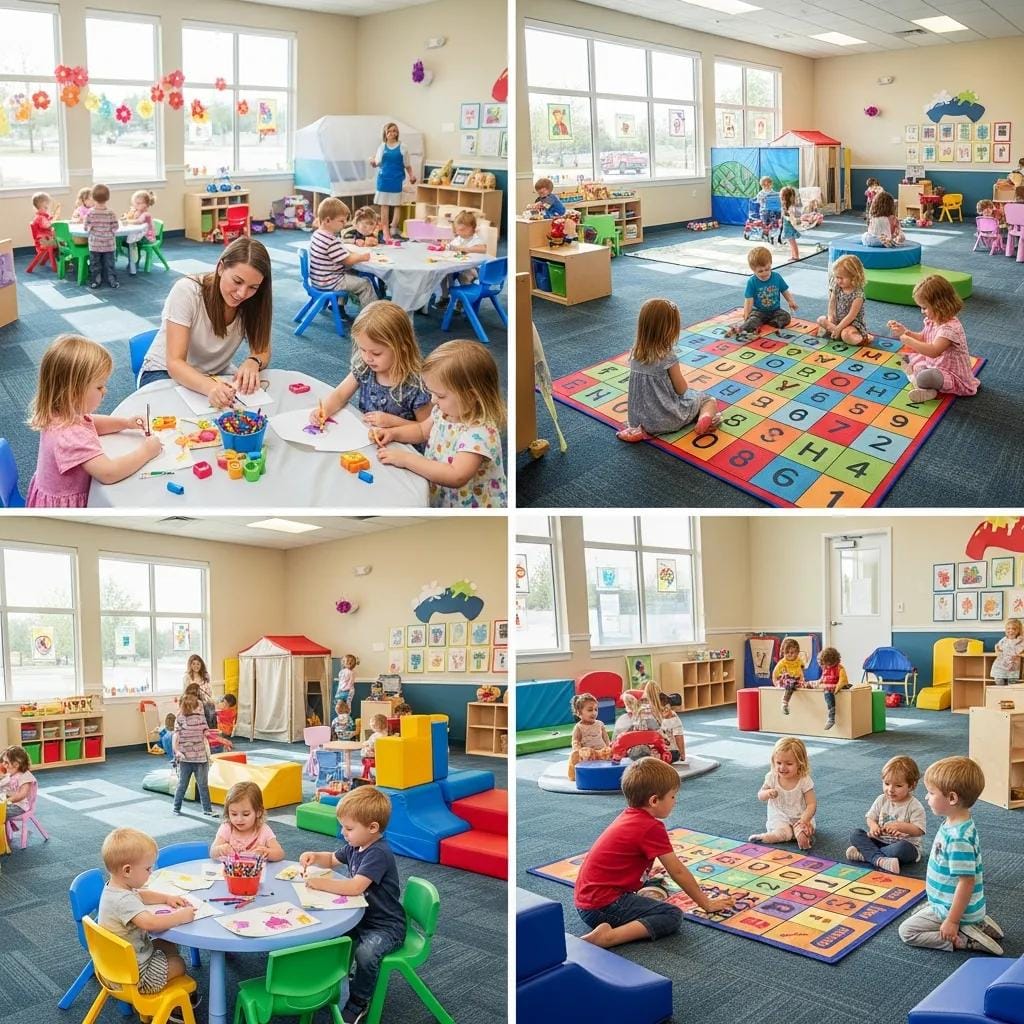
Child care franchises can generate higher per-location revenue but come with greater regulatory complexity, staffing needs, and facility requirements that shape risk and capital needs. Licensing, health and safety compliance, staff credentialing, and appropriate infrastructure influence both startup timing and ongoing costs. The trade-off is a larger capacity revenue balanced against higher payroll and facility expenses. The table below maps standard regulatory requirements to their operational impacts so you can estimate timelines and costs more accurately.
| Requirement | Jurisdiction / Applicability | Typical Impact on Operations |
|---|---|---|
| Staff-to-child ratios | State or regional licensing | Higher staffing costs limit capacity per room |
| Background checks & clearances | Universal in regulated markets | Longer hiring timelines; additional compliance costs |
| Facility safety & zoning | Local building codes | Build-out delays and extra capital for required upgrades |
Regulation has a direct effect on operations; prospective franchisees should bake these impacts into financing and launch timelines.
Child care franchises offer substantial community value and steady demand, but they require disciplined operations and robust HR systems. Before you commit, confirm the franchisor’s support for licensing, staff training, and facility design to reduce startup friction and surprises. Comparing regulatory burden with projected revenue clarifies whether capacity and fees will deliver acceptable margins.
How do child care franchises differ from other education franchises?
Child care franchises differ mainly in regulatory oversight, hours of operation, staffing intensity, and facility needs. They require continuous coverage during business hours, with higher staff counts and specific credentialing requirements, which increase payroll and scheduling complexity. Tutoring and specialty centers, which are usually run by appointment, allow leaner staffing and smaller spaces. Revenue models also vary: child care depends on daily or full-time enrollment, while tutoring often uses session-based or subscription revenue—differences that affect cash flow and sales strategies.
What regulations and standards affect child care franchise operations?
Key regulations include staff-to-child ratios, background checks, immunization and health rules, facility safety standards, and local zoning for educational use; specifics vary by state and country. These rules shape hiring timelines, required training, capital needs for safe facilities, and ongoing compliance costs—factors that can extend startup schedules. Prospective franchisees should confirm that the franchisor offers licensing support, compliant facility templates, and training on navigating local rules. Early clarity on these constraints helps avoid costly delays and keeps projected revenue timelines realistic.
How to Start and Grow Your Education Franchise Successfully?
Start and grow an education franchise by choosing carefully, modeling finances conservatively, and following a structured launch plan that prioritizes hiring, training, and local marketing. Growth comes from optimizing enrollment funnels, improving retention via measurable outcomes and clear parent communication, and using franchisor systems to add programs or open satellite sites. Track key metrics—enrollment, retention, CAC, lifetime value—to see which tactics deliver the best ROI and where efficiencies will raise margins.
Here’s a practical five-step starter plan that serves as a compact roadmap for new franchisees.
Follow this five-step launch plan to move from selection to opening:
- Research & Select: Shortlist franchise types, review FDDs, and speak with current franchisees for honest insights.
- Secure Financing & Plan: Build a conservative cashflow model, identify funding options, and finalize lease and build-out estimates.
- Site Selection & Build-Out: Pick a location based on demographics and access, then execute a franchisor-compliant build-out.
- Hire & Train: Recruit staff early, complete franchisor onboarding, and run pilot classes to smooth operations.
- Market & Open: Launch local marketing, host open houses, and track enrollments to improve conversion.
This plan focuses on clear milestones that turn careful evaluation into operational readiness and scalable growth. If you want help sourcing vetted franchisors, getting introductions to lenders, requesting curated leads, or speaking with a franchise advisor, these can speed the process—without skipping due diligence.
What are the key steps to launching an education franchise?
Launching a franchise requires coordinated legal, financial, operational, and marketing work to avoid delays and unnecessary cash burn. Start with thorough franchisor due diligence and review the FDD, then secure financing and sign the agreement. Next, find a site that fits your demographics and local rules, complete the build-out, and order curriculum materials. Hire and train staff with franchisor support, and run pre-opening marketing to build a pipeline before day one.
How can franchisees maximize growth and profitability?
To maximize growth, optimize the enrollment funnel with targeted local marketing, school partnerships, referral incentives, and a visible community presence to lower CAC and increase lifetime value. Improve margins through standardized onboarding, cross-training staff, and negotiating supplier terms. Add after-hours programs, seasonal camps, and add-on services to raise revenue per family, and use digital scheduling and online options to expand your reach. Finally, actively engage with franchisee networks to share best practices and shorten the learning curve as you scale to additional locations.
- Local marketing focus: Use search, school partnerships, and referral programs to attract families.
- Operational excellence: Standardize workflows, measure outcomes, and keep payroll efficient.
- Program diversification: Add camps, enrichment classes, and hybrid online options to boost revenue streams.
These tactics, paired with regular metric reviews, form a repeatable playbook for sustainable growth in education franchising. The final step is continuous improvement: measure, refine, and reinvest in the highest-return channels to protect long-term profitability.
Frequently Asked Questions
What are the initial steps to take when considering an education franchise?
Begin by conducting broad research to identify franchise options that match your interests and budget. Review the Franchise Disclosure Document (FDD) to understand fees, support, and track record. Assess local demand and competition, and talk with current franchisees to learn about day-to-day realities and profitability. Finally, build a conservative financial model to estimate startup costs and potential returns before you commit.
How can I ensure compliance with local regulations when starting a child care franchise?
Start by learning your state and local licensing rules—staff-to-child ratios, health and safety standards, and facility requirements. Work closely with the franchisor for documentation and licensing support, and contact local regulatory agencies to clarify specifics. Keep staff trained on compliance and maintain organized records to reduce risk and ensure a smooth opening.
What marketing strategies are effective for education franchises?
Effective tactics include local SEO to boost online visibility, community outreach through school and organization partnerships, and social media to connect with parents. Host open houses and free workshops to demonstrate value, and run referral programs that reward current families for introductions. Consistent branding and clear messaging across channels build trust and awareness locally.
What are the common challenges faced by education franchise owners?
Common challenges include meeting regulatory requirements, recruiting and retaining qualified staff, and consistently delivering high-quality education. Competition from local providers can affect enrollment, and marketing effectively to the right parents takes ongoing effort. Operational issues such as scheduling and curriculum delivery also require robust systems. To tackle these challenges, use franchisor support, invest in staff training, and iterate your marketing based on community feedback.
How can technology enhance the operations of an education franchise?
Technology streamlines administration, improves communication, and supports learning. Management platforms handle enrollment, scheduling, and billing, while online curriculum and progress-tracking tools enable personalized instruction. Digital marketing and analytics help target and measure campaigns. The right tech stack improves efficiency and delivers data you can use to grow more strategically.
What are the benefits of joining a franchise network compared to starting an independent education business?
Joining a franchise gives you a tested business model, brand recognition, and structured training and support. Franchisees benefit from group purchasing power, established marketing playbooks, and a community of peers sharing best practices. That structure lowers the risk of starting alone and can speed your path to stable operations and growth.
Conclusion
Education franchising offers a compelling way to enter a growing market with predictable demand and scalable business models. By understanding franchise types, their trade-offs, and how to evaluate costs and operations, you can choose an opportunity that suits your goals and community. Take the next step by conducting detailed due diligence, speaking with franchisees, and connecting with trusted franchise resources to find the right fit for your investment and long-term ambitions.